Pollinator Paradise Parma R & E Center
PSES
College of Agriculture
University of Idaho
Research slide shows
Bee management
Philosophy
Links
Contact us
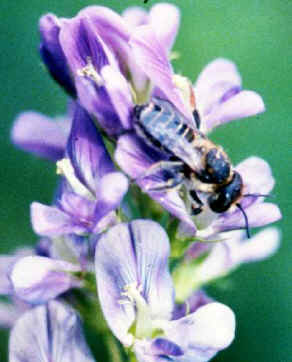
Fig. 1: Tripped flowers on a raceme. What do they really mean?
|
See an interactive model
of alfalfa pollination. If you want to try to measure the amount of pollination that is taking place in an alfalfa field, it is natural to count numbers of open flowers, tripped flowers, and perhaps buds and wilted flowers on a sample of racemes. Here is something to think about if you plan to make these measurements. Your counts will be a snapshot in time of the condition of the raceme. Counts per se give you no information about the rate at which flowers are opening or being tripped. Those two rates may be very different. You need to know both of these rates in order to interpret changes in numbers of open flowers over time, and to make comparisons between fields and between years. Open flowers that are not tripped remain open for about a week. Flowers that are tripped wilt within an hour or so. Temperature plays a role in these rates, but the difference is great. In some plant species it has been demonstrated that pollination triggers a peak in ethylene production, and this spike in ethylene production results in senescence of the flower1,2,3. Thus there is a likely physiological mechanism for the difference flower duration in pollinated vs. unpollinated alfalfa flowers. The number of tripped flowers at a given moment in time tells you how many flowers were tripped in the past hour or so. If a flower was tripped more than an hour earlier, then it will probably be counted in the wilted flower category. On the other hand, the number of open flowers tells you how many flowers opened sometime in the past week, but have not yet been tripped. |
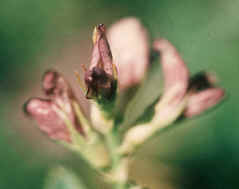
Fig. 2: A wilted flower < 2 hrs after being tripped. |
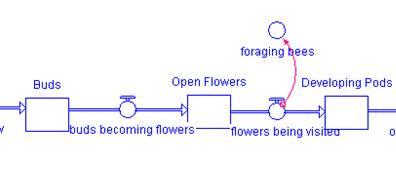
Buds, Open flowers, and Developing Pods are accumulations. Like a bathtub filling with water, the level in the accumulation increases or decreases depending on the relative rates of inflow (like a faucet) and outflow (like a drain). Inflows and outflows are rates of change over a very brief time period. In this representation, tripped flowers are an outflow, "flowers being visited", from the open flower accumulation. |
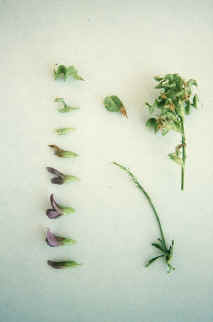 Fig. 3 - Flower development. The phenology of alfalfa flowering, starting with buds (bottom) through open flower, wilted flower, and seed pod development. Bottom right is a raceme with all flowers removed; pedicels along the raceme indicate where a flower was attached. Top right is a raceme with maturing curls. The rate of development in each flower stage is different. Unless you know the rates, it is difficult to interpret the meaning of the numbers of each stage at a moment in time. |
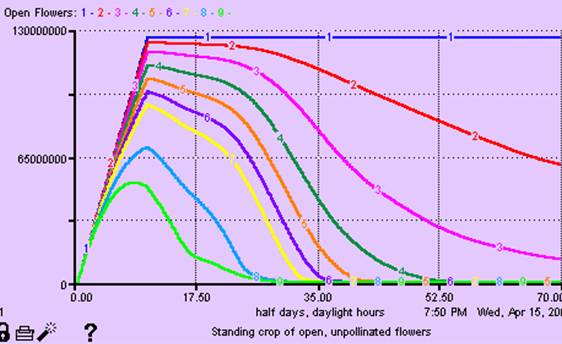 However, Open Flowers increase as the inflow, rate of buds becoming flowers increases. Thus increases in the inflow and the outflow have the opposite effect. For example, Breazeale et al. use multiple linear regression models to compare open flowers and tripped flowers between a number of fields and between shelters within fields. Thus, they measured the accumulation and it's outflow (two variables that are not independent). They found more tripped flowers in fields with more open flowers. Is this because fields with more tripped flowers had a more rapid rate of pollination, or a more rapid rate of bud opening? We don't know without some measure of the inflow into the open flower accumulation. However, the model suggests that these fields probably differed more in rates of bud opening than in pollination rates, because increased pollination rates should have reduced the number of open flowers for a given rate of bud opening. Rates of bud opening probably differ considerably between alfalfa varieties and between fields under different management. In contrast, tripped flowers decreased with distance of the flowers from a bee shelter. This difference is likely due to decreased pollination further from the shelter. Within a field the rates of bud opening probably are not as variable as between fields, but pollinators may be slower to reach areas further from the shelter. A measure of the inflow into the open flower accumulation is needed to confirm this interpretation. One way to measure the rate of bud opening would be to make counts throughout the day after similar periods of time, say every 2 or 3 hours. Count and mark the flowers on a raceme that opened, and flowers that were tripped, in each time period . Or perhaps you could prepare racemes before a measurement period so that all except buds are removed. Then wait 2 hours, and count the number of open, tripped and wilted flowers. Temperature, time of day, and variety are likely to affect the rate of flower opening.
|
| Many people have difficulty thinking about the dynamics of a system. Some may have a hard time understanding how to translate this dynamic view of alfalfa bloom into a sampling scheme for research. Your sampling scheme depends on the question that you want to address. If you want to brainstorm about the best sampling scheme for your research, I invite you to contact me. |
I've observed that flowers open gradually throughout the
day. Very few flowers open at night, as far as I can tell, although
I have not tried to prove this. The rate of flower opening is
probably accelerating in the morning and decelerating in the afternoon,
but again this has not been measured. Thus, your counts of tripped
flowers will mean different things at different times of day.
If however, you count open flowers at the end of the day, you are counting flowers at a time when no more flowers are opening, and no more pollination is taking place. You are seeing what is left over after a of a day of pollination. Hence, counts made at the end of the day tell you something about how well the pollination has been going that day. (But they don't quantify the amount of pollination or the amount of bloom that day). Don't expect to see tripped flowers once the bees have stopped foraging. Flowers that are still open will be available for the bees first thing in the morning. If pollination is heavy relative to the amount of bloom, only buds and wilted flowers will be left on the raceme. I hope that this helps alfalfa seed growers and researchers understand why sampling in the evening works. It should also help researchers of alfalfa pollination design experiments. How many bees should I introduce to my field? A rule of thumb. Alfalfa is an indeterminate bloomer, like many crops. That means that it continues to bloom as long as conditions are appropriate and the fruits do not mature. Read about the implications of indeterminate blooming in my essay Squash, Beans, and Deadheading Flowers. See also the publication How an Alfalfa Plant Develops from the National Alfalfa Alliance. |
| References 1 Jones, M. L. and W. R. Woodson. 1997. Pollination-induced ethylene in carnation. Plant Physiol. 115:205-212. 2 De Martinis, D., G. Cotti, S. te Lintel Hekker, F.J.M. Harren, C. Mariani. 2002. Ethylene response to pollen tube growth in Nicotiana tabacum flowers. Planta 214: 806–812. 3 Muller, R. and B. M. Stummann. 2003. Genetic regulation of ethylene perception and signal transduction related to flower senescence. Food, Agriculture and Environment 1:87-94. |
Top of page Pollinator Paradise
Parma R & E Center
PSES College of Agriculture
University of Idaho
Research slide shows
Bee management
Philosophy
Links
Contact us
Copyright © 2003, Karen Strickler. All rights reserved.